



Founder Series | Startup Team Disengagement: Why Founders Lose Their Best People During Scaling
- Frank November

- Apr 20
- 13 min read

A founder closes her laptop at 6:15 on a Tuesday evening and notices the office is already empty. Six months ago this room had people in it until nine. Now the chairs scrape back at 5:00 sharp, and the Slack channel that used to buzz with ideas is mostly just task updates. Her three best engineers have been in the office today and none of them stopped by her desk to talk about anything.
She's going to interpret this as a work-life balance success. Her team finally has boundaries. Good for them.
Six weeks later the lead engineer hands in her notice. Two weeks after that, the head of product announces he's taking a role at a competitor. The founder will spend the next month trying to figure out what went wrong, and she'll mostly look in the wrong place — compensation, equity, market conditions, the specific manager each person reported to. The actual answer is that the team checked out four months before anyone quit, and nobody named what was happening.
Startup team disengagement rarely looks like rebellion. It looks like quiet withdrawal — the gradual shift from people who stay late because they can't imagine leaving to people who leave on time because they can't imagine staying. The gap between those two states is usually invisible while it's happening, and obvious only in retrospect.
Key Takeaways
Disengagement is a behavioral signal, not a culture problem.
The warning signs are observable in how people interact long before they show up in engagement surveys or exit interviews.
The founder's unscaled leadership style is usually the root cause.
What worked at ten people actively causes disengagement at forty, and most founders don't see the shift happening.
Hiring better people doesn't fix it.
High performers disengage faster than average performers when the system around them is broken. They just have more options.
Psychological safety is the prerequisite, not the outcome.
Teams that can name friction openly stay engaged. Teams that can't, don't.
Everything DiSC® gives the team a shared vocabulary for the friction.
A behavioral assessment makes the unspoken patterns nameable, which is the first step to addressing them.
The Shape of Disengagement Before the Resignations Start
Conclusion first: By the time a star performer resigns, disengagement has usually been present for three to six months. The resignation is the final step of a process, not the start of one. Founders who wait for the resignation to take action are always working on the wrong timeline.
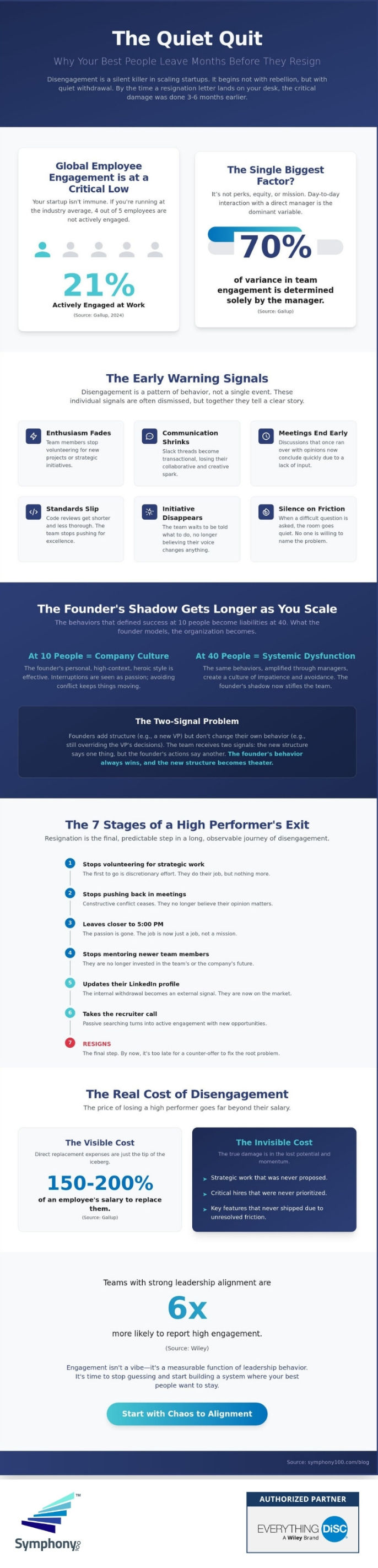
The early signs are behavioral, not verbal. People stop volunteering for new projects. Meetings that used to run over because everyone had opinions now end early because nobody does. Code reviews get shorter. Slack threads get more transactional and less collaborative. When someone asks a difficult question in a meeting, the room goes quiet in a way that it didn't used to.
In working with startup teams, the pattern I see most often is that founders notice these signs individually without noticing them as a pattern. The quiet meeting gets chalked up to everyone being tired. The shorter code review gets chalked up to the team being efficient. The missing volunteer for the new project gets chalked up to everyone being busy with their current work.
Each individual signal has a plausible explanation. Taken together, they almost always mean the same thing: the team has stopped believing that their voice changes anything.
Engaged Teams Look Different in Ways You Can Measure
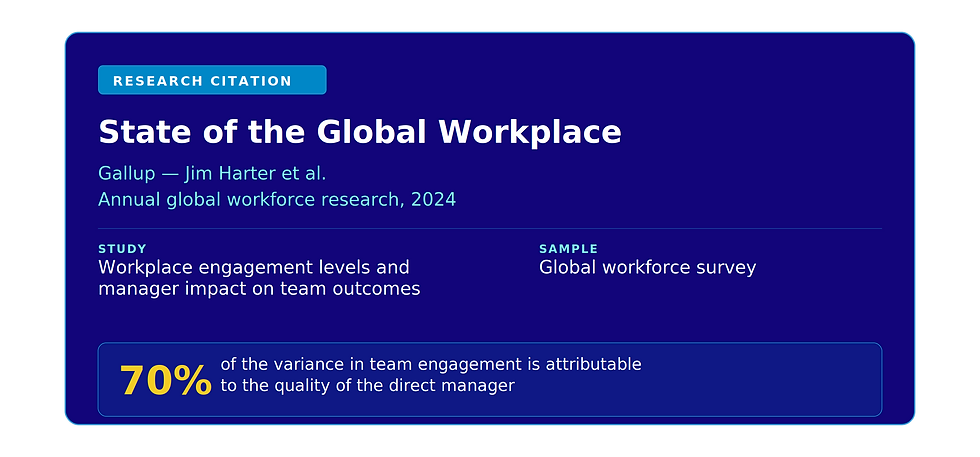
Gallup's global engagement data has held roughly stable for years, and the 2024 numbers show the baseline is not strong — global engagement sits at 21%, which means roughly four in five employees are not actively engaged at work. That is the floor your startup is starting from. If your scaling company is running at industry average, you already have a disengagement problem; you just haven't named it yet.
What separates engaged teams from disengaged ones is not perks, compensation, or mission. It is the quality of day-to-day interaction with the direct manager. Gallup's longitudinal work shows managers account for 70% of the variance in team engagement. Everything else you worry about as a founder — equity, benefits, office space, brand — is noise compared to that single variable.
Why the Founder's Shadow Gets Longer as the Company Grows
There is a particular dynamic that shows up in scaling startups and almost never gets named out loud. The founder's behavior at ten people is the company's culture. At forty people, the founder's behavior is still the company's culture, but the founder is no longer in most of the interactions that define it. What the founder models at the top cascades through every layer of the organization, amplified rather than diluted as it travels down.
This means the specific behaviors a founder did not examine carefully at ten people become the behaviors that define thirty people, then fifty, then one hundred. A founder who interrupts when impatient at ten people has a leadership team that interrupts when impatient at fifty people. A founder who avoids hard conversations at ten people has a leadership team that avoids hard conversations at fifty people. This is not a training problem; it is a modeling problem, and it cannot be solved downstream of the founder.
The Unscaled Leadership Style
In my work with scaling founders, the transition from ten to fifty employees is where most leadership styles fail quietly. The style that got the company from zero to ten was personal, responsive, high-context, and often heroic. The style that gets the company from ten to fifty has to be something else — more delegated, more documented, more explicit about expectations. Most founders intellectually understand this. Far fewer actually change their behavior, because the early style is what made them successful in the first place, and nobody enjoys abandoning what works.
What I see most consistently is founders who add structure and process to their companies without changing their own behavior. The VP of Engineering now runs the engineering review, but the founder still interrupts it. The head of product now owns the roadmap, but the founder still changes it on Slack without consultation. The team receives two simultaneous signals: the new structure says one thing, the founder's behavior says another. In that conflict, the founder's behavior always wins, and the new structure becomes theater.
What Disengaged High Performers Do Before They Leave
High performers disengage in a specific sequence. First they stop volunteering for strategic work. Then they stop pushing back in meetings. Then they start taking longer lunches and leaving closer to five. Then they stop mentoring newer team members. Then they update LinkedIn. Then they take the recruiter call they've been ignoring. Then they resign. The resignation is stage seven, and every stage before it was observable.

The Real Tax: Manager Debt and Engagement Variance
The financial cost of disengagement is usually discussed in terms of replacement cost. Gallup's research on this is direct: replacing a senior leader runs roughly 200% of their salary; technical roles run 100% to 150%. Those numbers are the visible cost. The invisible cost is larger and harder to measure: the strategic work that didn't get proposed because a disengaged senior contributor stopped pushing, the hire that didn't get made because a disengaged manager didn't prioritize it, the feature that didn't get shipped because nobody was willing to have the hard conversation about scope.
What Wiley's workplace research has found is that teams are 6x more likely to report high engagement when leadership alignment is strong. The signal running through all of this work is consistent — engagement is not a vibe, it is a measurable function of how leadership behaves toward the team. When leadership is aligned, engagement compounds upward. When leadership is not, engagement compounds downward, and the decline is usually invisible until a resignation letter makes it visible.
The Manager Training Gap
Gallup's data shows that only 44% of managers globally receive any management training. In a startup context, the number is almost certainly lower. Most startup managers are promoted from individual contributor roles because they were good at the IC work, thrown into a management job with zero training, and then expected to figure out how to lead a team while also delivering their own work. This is a structural problem, not a talent problem, and it is one of the biggest silent contributors to disengagement at scaling companies.
The managers who succeed in this environment are the ones who get deliberate about learning the job. The managers who don't end up managing by imitating either the founder's style or whatever behavior pattern they observed in their own previous managers. Both options usually produce disengagement, because neither is a trained skill — it is pattern-matching on examples that may or may not have been good.
What Psychological Safety Actually Means (And What It Doesn't)
Psychological safety gets talked about a lot in startup culture conversations, and it usually gets talked about wrong. It is not about being nice, it is not about avoiding conflict, and it is not about making everyone comfortable. Amy Edmondson's definition is more precise than most founders realize: psychological safety is the belief that one will not be punished or humiliated for speaking up with ideas, questions, concerns, or mistakes.
What that definition makes clear is that a psychologically safe team is not a conflict-free team. It is a team where the conflict is visible and productive rather than silent and toxic. The quiet meetings and the polite Slack threads that founders sometimes read as signs of healthy culture are almost always the opposite — they are signs of a team that has learned, from experience, that speaking up doesn't go well.
Google's Project Aristotle research found psychological safety was the single largest predictor of high-performing teams at Google, ahead of team composition, clarity, and dependability. The finding is worth taking seriously because it points to where the leverage actually is. If you want to reverse disengagement, you do not start with perks or compensation. You start with whether people can actually say what they think without it costing them.
The Pattern That Signals You Don't Have It
The signal that a team lacks psychological safety is rarely that someone is loud about being unsafe. The signal is that nobody is loud about anything. When you ask a room full of people for their honest take on a strategy, and everyone offers variations on the same mild agreement, you do not have alignment — you have a team that has decided disagreement is not worth the cost.
Lencioni's formulation on accountability applies here too: failing to hold someone accountable is ultimately an act of selfishness. The founders who avoid hard conversations with underperformers are not protecting those people. They are protecting themselves from the discomfort of the conversation, and the cost of that protection is paid by every high performer who watches the under-performer stay and decides this company is not where they want to be.
A Practical Framework for Reversing Disengagement
Reversing disengagement is harder than preventing it, but it is possible if the founder is willing to examine their own behavior first. The tactical steps come second. No intervention works if the founder is still running the behavior that caused the disengagement in the first place.
Step One: The Founder Behavioral Audit
Before any team intervention, the founder needs an honest read on their own behavior. The useful question is not "am I a good leader?" It is "what specific behaviors of mine, observed over the last three months, could plausibly have contributed to disengagement?" This is a hard question to answer alone, which is where a behavioral assessment earns its place — it provides a neutral mirror rather than a self-assessment that inevitably skews favorable.
The Everything DiSC® Workplace assessment surfaces the gap between a founder's natural style and the adapted style they operate in under pressure. That gap is usually where the unexamined behavior lives. A founder whose natural style is action-first will, under pressure, become even more action-first — interrupting more, deciding faster, consulting less. The team feels the shift even when the founder doesn't.
Step Two: Manager Capability Assessment
Once the founder behavior is visible, the next question is whether the managers below the founder are equipped to do their jobs. Most scaling companies have managers who have never been trained to manage. Fixing this is not a one-off training event; it is an ongoing capability build that includes clear expectations, real coaching, and feedback mechanisms that actually function.
The shortcut some founders try is to replace struggling managers with more experienced hires. This sometimes works, but it also often fails — an experienced manager walking into an environment where the founder still models bad behavior will either adapt to the dysfunction or quit. The underlying environment has to change first.
Step Three: Psychological Safety Baseline
With founder behavior examined and manager capability honest, the team can now work on whether people actually feel safe speaking up. This is not accomplished by announcing that the team is safe. It is accomplished by demonstrating, repeatedly, that speaking up does not have costs — and by the founder being visibly willing to hear things they don't want to hear.
The test is simple: when someone raises a difficult topic in a meeting, what happens in the next forty-five seconds? If the founder's response is defensive, dismissive, or quick to explain why the concern is wrong, the team has now received another data point that speaking up is not safe. If the founder's response is curious, slow, and genuinely engaging with the concern, the team has received the opposite signal. These small moments, repeated, are what actually build or destroy psychological safety.
Step Four: Sustained Cadence
The work is not an event. Reversing disengagement takes months of consistent behavior, not a single offsite. What holds the reversal in place is cadence — regular 1:1s that actually address how the person is doing, not just status updates; team meetings where dissent is explicitly welcomed; clear decision-making processes that don't get overridden by founder whim.
In my work as an Everything DiSC® and Five Behaviors® Authorized Partner, the pattern I see in teams that successfully reverse disengagement is always the same. The founder changed first. The structures changed second. And the team got time — usually three to six months of consistent new behavior — before the engagement actually returned. Founders who expect a one-week fix do not get one.
Why the Usual Fixes Don't Work
Most founders respond to disengagement by trying to inject energy back into the team — an offsite, a new benefit, a mission-refresh all-hands, a compensation review. These interventions almost always fail to reverse disengagement, because they treat the symptom rather than the cause. A disengaged team does not need more perks; it needs to believe that the daily experience of working there is going to be different going forward.
The perks response is particularly common because it feels active and low-risk. Adding a new benefit is something the founder can do quickly. It looks caring. It costs money rather than behavioral change. But perks don't address the actual problem, which is that the team has stopped believing their voice matters. No amount of free lunch compensates for that belief.
The second common response is to hire a head of people or a VP of engineering to "fix the culture." This is useful if the hire is empowered to actually change things, but it usually fails because the founder is not willing to be changed by the hire. The new executive arrives, diagnoses the problem accurately, and then discovers that every recommendation they make hits a wall at the founder's office door. Six to twelve months later, they leave.
The Work That Actually Re-engages a Team
The founders who successfully reverse team disengagement share one characteristic: they stopped trying to fix the team and started working on the system the team operates in. That system includes founder behavior, manager capability, decision-making processes, and whether hard conversations actually happen when they need to.
None of this is fast, and none of it is comfortable. The honest version of the work is that a founder has to examine their own patterns and change them, which is the single hardest leadership task in scaling a company. Most founders find it more comfortable to change the team than to change themselves. That preference is exactly why most disengagement reversals fail.
If the patterns in this article are familiar, the place to start is with an honest behavioral audit of how you actually lead, followed by the infrastructure to hold the changes in place. The course Chaos to Alignment™ for Startups in 30 Days, a course from Symphony 100, walks founding teams through that process step by step. Whether you use this course or build your own protocol, the move is the same: stop asking why the team stopped caring, and start asking what about the environment made that a rational response.
Frequently Asked Questions
How long does it take to reverse startup team disengagement?
Three to six months of consistent behavioral change is typical, and that assumes the founder is actively working on their own behavior. Faster than that is rare. The team needs time to believe the change is real, which it will only do after watching it hold through multiple moments where the old behavior would have shown up and didn't.
Why do high performers disengage faster than average performers?
High performers have more options, and they notice dysfunction earlier because they are more engaged with the strategic picture. When the system breaks down, average performers often stay because the alternative feels uncertain. High performers get recruited easily and can afford to leave. They also tend to be the ones trying hardest to fix things, which means they feel the cost of being ignored most acutely.
Is disengagement always the founder's fault?
The founder is usually not the only cause, but the founder is almost always a significant part of the cause in a startup under 100 people. The company is small enough that founder behavior cascades directly. In larger organizations, the disengagement might originate three layers down from the CEO. In a fifty-person startup, it rarely does.
Can a behavioral assessment tell us who is disengaged?
A behavioral assessment like Everything DiSC® does not measure engagement, and it should not be used as a disengagement detector. What it does is give the team a shared vocabulary for the behavioral patterns that often underlie disengagement — communication style mismatches, stress responses, differences in how people process decisions. That vocabulary makes the underlying dynamics nameable, which is usually the first step toward addressing them.
What if the founder isn't willing to change their own behavior?
Then the disengagement will not reverse. This is a hard truth and one that most consultants soften, but it is what the pattern actually shows. The team takes its cues from the top, and if the top is not willing to model different behavior, no amount of downstream intervention will hold. In this situation, the honest conversation is whether the founder is willing to engage with their own behavior or whether they would rather accept the ongoing cost of disengagement.
How is this different from a normal engagement survey?
Engagement surveys measure outcomes — how people feel. They tell you the problem exists, but they rarely tell you why. The behavioral work described in this article examines the mechanisms that produce those outcomes — what the founder actually does, how managers actually lead, what happens in meetings when someone raises a concern. Surveys are useful for detection. Behavioral work is what actually changes the outcome.
Should we tell the team we're working on this?
Generally yes, but carefully. Telling the team "we're working on culture" without specifics tends to raise cynicism, because the team has usually heard some version of this announcement before. What works better is naming specific behavior changes that are going to happen, and then actually doing them. Less announcement, more demonstration.
How much does a behavioral assessment program for our team cost?
Pricing varies by team size and configuration. Contact us for a quote tailored to your situation.


Comments