



Founder Emotional Intelligence Under Series A Pressure
- Frank November

- Apr 2
- 14 min read
Updated: 5 days ago

Why EQ — Not IQ — Determines Whether Your Startup Scales or Stalls
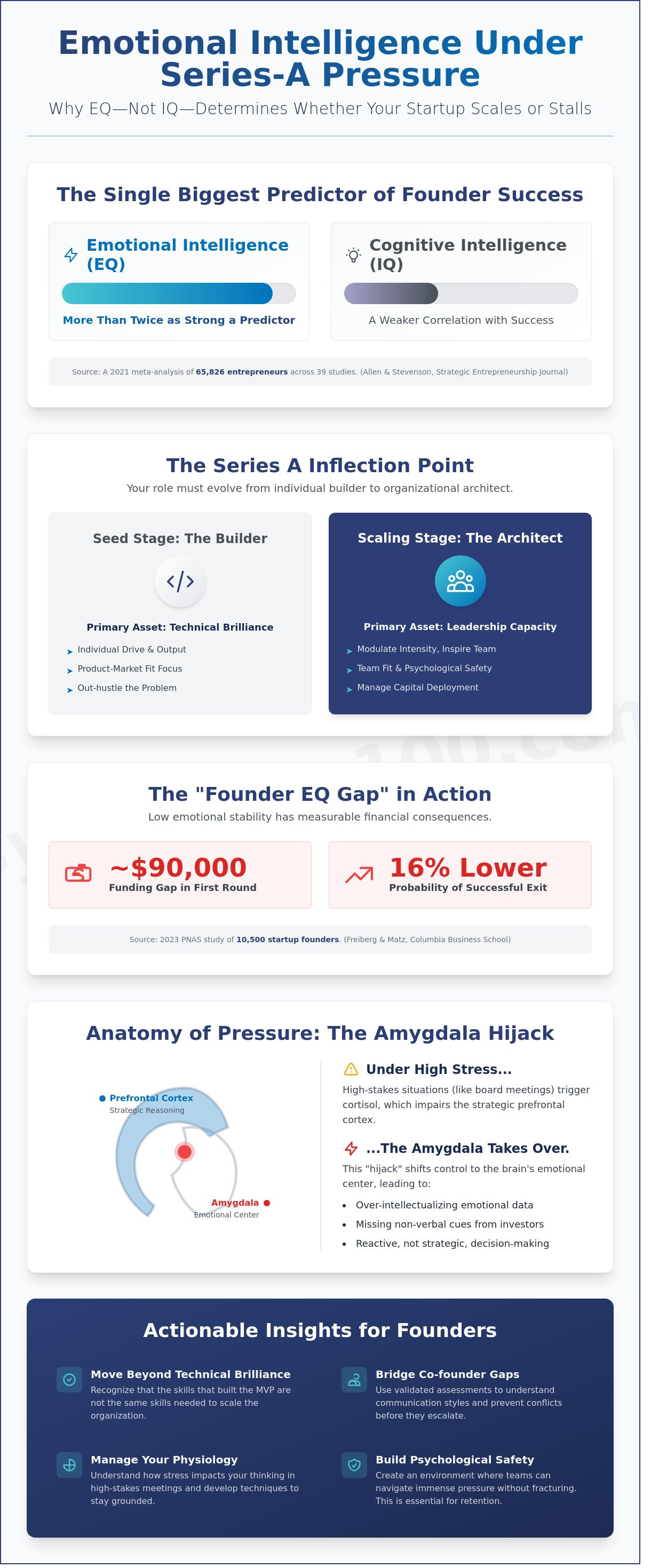
Emotional intelligence is more than twice as strong a predictor of entrepreneurial success as cognitive intelligence. That’s the finding of a 2021 meta-analysis examining 65,826 entrepreneurs across 39 studies, published in the Strategic Entrepreneurship Journal by researchers at Indiana University’s Kelley School of Business (Allen & Stevenson, 2021).
For Series A startups (“startups”), this finding carries urgent practical weight. You’re sitting with a term sheet that demands 300% growth, your co-founder is going silent on Slack, and your head of engineering just quit. In that moment, your technical brilliance isn’t what will save you. Your capacity to lead under pressure — to regulate your own reactions, read the room, and hold your team together — is the asset that determines whether you reach Series B or become a post-mortem case study.
This article explores why emotional intelligence may be the critical requirement for navigating the transition from seed-stage builder to funded-stage organizational leader. We’ll look at frameworks that can help reduce co-founder conflict, stabilize teams during rapid hiring, and support better decision-making when the pressure is at its highest.
About the Research:
This article draws on Allen & Stevenson's 2021 meta-analysis of 65,826 entrepreneurs across 39 studies, published in the Strategic Entrepreneurship Journal (Wiley), which found that emotional intelligence is more than twice as strong a predictor of entrepreneurial success as cognitive intelligence.
Supporting research includes Freiberg & Matz (2023, PNAS, n=10,500 founders) on founder emotional stability and venture outcomes, and Richardson (2024, UCL School of Management /Foundology, n≈400) on founder isolation and resilience.
Key Takeaways - Founder Emotional Intelligence Under Series A Pressure
Technical brilliance has a ceiling
The skills that built your MVP may not be sufficient for the organizational demands of scaling beyond Series A — and recognizing that shift is the first step.
Stress changes how you lead
Physiological stress responses can impair strategic thinking during high-stakes board meetings. Self-awareness and self-regulation are competitive advantages, not soft skills.
Behavioral data reduces guesswork
Validated behavioral assessments like Everything DiSC® on Catalyst™ can help co-founders understand and bridge communication gaps before they become existential threats.
Psychological safety drives execution
Building genuine trust — not surface-level harmony — may be essential for startups navigating institutional funding pressure and rapid hiring.
The Series A Inflection Point: Why IQ Is No Longer Enough
The Execution Risk No One Talks About
The counter-intuitive truth of scaling is that your Series A is a psychological stress test, not a technical one. Some founders believe that the same raw brilliance that built the MVP will carry them through expansion. In many cases, it won’t. Technical genius is increasingly commoditized; the ability to lead a high-stakes, rapidly growing organization is the rarer asset.
Picture the scenario: Q3, $15M in fresh capital, headcount doubled. Yet execution velocity is stalling. Features ship late. Your best engineers look exhausted. You’re working 18-hour days but the needle isn’t moving. This is what we might call the “Founder EQ Gap” in action. High-growth environments often don’t fail because the code is bad. They fail because the founder’s leadership capacity becomes the primary bottleneck to scale.
A 2023 study published in PNAS (Freiberg & Matz, Columbia Business School) analyzed 10,500 startup founders and found that founder emotional stability predicted outcomes across all stages of venture development — from seed through exit. Founders scoring low on emotional stability faced an approximately $90,000 funding gap in their first round and a 16% lower probability of a successful exit. EQ isn’t a “nice to have.” The data suggests it’s a measurable determinant of startup outcomes.
From Builder to Organizational Architect
The transition from what some practitioners call the “Garage Phase” to the “Scaling Phase” requires a fundamental shift in operating mode. During the seed round, your individual drive and output — your personal “amperage” — was your greatest asset. You could out-code, out-sell, and out-hustle any problem. Past the Series A threshold, that same intensity, without the emotional intelligence to modulate it, can erode team morale. High standards start feeling like micromanagement. Passion starts feeling like volatility.
Reframing EQ: Consider viewing emotional intelligence not as a “soft skill” but as a technical requirement for managing a $10M+ capital deployment.
The Technical Brilliance Trap: Technical expertise can create a false sense of security. It helps build the product, but building the company requires a different set of capabilities.
Team Fit: While the seed round was about Product-Market Fit, the scaling phase is arguably about Team Fit — aligning your leadership style with the needs of a professionalizing workforce.
IEEE research on engineering management transitions identifies what they call a “competency displacement phenomenon”: the technical mastery that propels engineers and scientists to senior individual contributor roles often bears little resemblance to the competencies required for leadership success. Professionals who spent careers being rewarded for individual performance — in labs, in codebases, in research — may find the shift to team-dependent success particularly challenging. In a startup, where outcomes depend entirely on collective execution, this gap can become the difference between scaling and stalling.
When psychological dynamics go unaddressed, execution risk increases. Investors aren’t just evaluating your burn rate; they’re watching your churn rate. If the leadership team can’t retain the talent it spent millions recruiting, the cap table suffers.
The Anatomy of Pressure: Managing the Amygdala in the Boardroom
The Series A milestone isn’t just a financial event; it’s a physiological transformation. When a founder sits across from a lead investor questioning a drop in month-over-month growth, the body doesn’t distinguish between a predatory threat and a cap table concern. Research on the neuroscience of stress confirms that high-stakes evaluative situations trigger significant cortisol responses, which can impair the prefrontal cortex — the seat of strategic reasoning — and shift control to the amygdala, the brain’s emotional center. This is what Daniel Goleman termed the “Amygdala Hijack.”
High-IQ founders can fall into the trap of over-intellectualizing this emotional data — treating the palpable tension in the room as irrelevant noise rather than critical feedback. When a founder misses subtle shifts in investor sentiment because they’re locked into a data presentation, they may find themselves blindsided by lost confidence and lost follow-on funding.
It’s worth remembering that the majority of human communication is non-verbal — tone, facial expression, body language. In today’s environment, where much founder communication happens through Slack, email, and video calls, those non-verbal signals are often stripped away entirely.
Founders who are aware of this gap, and who deliberately create space for face-to-face dialogue and real-time reading of the room, may find themselves at a significant advantage.
The cost of low EQ shows up as what we might call a “Team Tax” — a drag on productivity that compounds across every department when a founder lacks emotional regulation. Every strategic shift costs more in confusion, lost morale, and rework.
The Isolation Factor
There’s a dimension of founder pressure that often goes unspoken: loneliness. When you’re the person ultimately responsible for payroll, for investor relationships, for the team’s direction — and you have no true peers inside the organization — the isolation can erode the very judgment you need most. A founder who is emotionally depleted makes different decisions, and those decisions ripple through the entire organization.
The data supports this. A 2024 Founder Resilience Research Report from UCL School of Management (Christina Richardson, Foundology), studying nearly 400 entrepreneurs globally, found that 76% of founders report feeling lonely — seven times the workplace average and 50% more than CEOs of established companies. This loneliness directly impacts self-confidence, self-efficacy, and problem-solving capability. For startup leaders, it’s not just a personal burden; it’s a group dynamics issue with real consequences for team performance and organizational outcomes.
Understanding Your Natural Style Under Pressure
Every person has a natural behavioral style — a default way of communicating, making decisions, and relating to others. Under pressure, we tend to lean more heavily into that style. A founder whose natural tendency is toward directness and decisiveness may become even more blunt when stressed. A founder who naturally values precision and analysis may withdraw further into the data, leaving the team without clear direction.
The key insight from behavioral science isn’t that any style is “better” or “worse” — all styles bring essential strengths depending on the situation. The challenge is awareness. Without it, founders can dig deeper into their natural tendencies in ways that others may misinterpret through the lens of their own style. With awareness, you can recognize what’s happening and adjust your approach based on the circumstances and the needs of the people you’re working with. Everyone carries elements of all styles; the question is whether you’re choosing consciously or reacting automatically.
Self-Regulation as a Competitive Advantage
Maintaining executive presence requires the ability to recognize biological stress signals before they dictate action. It can prevent “rage-hiring” to solve temporary capacity issues or impulsive pivots that burn runway. EQ, at its core, is the ability to create space between a trigger and a response. Self-aware founders use that space to evaluate whether a board member’s critique is a threat or an opportunity for alignment.
Co-Founder Friction:
Navigating the Most Expensive Relationship in Tech
The co-founder relationship may be the single most consequential risk factor on your cap table. While seed rounds can accommodate “creative tension,” the arrival of institutional capital acts as a magnifying glass for every unaddressed grievance. When the pressure to scale intensifies, communication breakdowns between co-founders become visible — to the team, and to the board. If you’re debating hiring priorities or burn rates in front of your lead investor, you’ve already lost the room.
Using Behavioral Data to Understand Conflict
Co-founder conflict often stems from fundamental differences in behavioral priorities rather than a lack of competence. Validated behavioral assessments — such as Everything DiSC® on Catalyst™ — can help make these differences visible and actionable.
Consider two co-founders: one whose natural style prioritizes speed, bold action, and results, and another who values thoroughness, stability, and careful analysis. Neither is wrong. But without a shared language for understanding these differences, each may interpret the other’s behavior as a personal failing rather than a different but equally valid approach to the same challenge.
Without this awareness, co-founders sometimes retreat into what we might call “Shadow Board” behavior — privately lobbying stakeholders or employees to gain leverage against each other. This erodes trust and creates organizational silos that are difficult to dismantle later.
The Cost of Misalignment
Noam Wasserman’s research at Harvard, published in The Founder’s Dilemmas (Princeton University Press, 2012), drawing on data from approximately 10,000 founders, found that 65% of startup failures were attributable to “people problems” — co-founder conflict, misaligned expectations, and team dysfunction. This isn’t a soft-skill issue; it’s an execution risk that directly impacts valuation and the ability to attract follow-on capital.
Every startup’s situation is different, but founders who have navigated this successfully often share a few common practices worth considering:
Founder Alignment audit: Mapping specific decision rights for product, spend, and hiring to remove ambiguity.
“State of the Union” meetings: Dedicating time weekly to discuss the health of the partnership, separate from operational updates.
Conflict protocols: Agreeing on a third-party mediation process before a stalemate occurs, not after.
Chaos to Alignment™ for Startups in 30 Days, (https://www.chaostoalignment.com) is a course from Symphony 100, addresses frameworks for these kinds of alignment conversations. Managing co-founder dynamics requires moving beyond ego into a structured partnership where roles and decision rights are as clearly defined as your technical architecture.
Building a Cohesive Startup Team: Beyond the Ping-Pong Table
You’ve just closed your round, and the board is expecting 3x growth in 18 months. You’re hiring ten people a month, yet leadership meetings feel strangely quiet. Everyone nods at the roadmap, but execution lags. This isn’t alignment; it’s what Patrick Lencioni, in The Five Dysfunctions of a Team (Jossey-Bass/Wiley, 2002), calls “artificial harmony.” Under pressure to move fast, founders sometimes avoid friction altogether — and that avoidance is precisely what causes execution to seize.
The Trust Foundation
Vulnerability-based trust is the foundation of a high-performance team. It’s the willingness of team members to be open about mistakes and limitations without fear of reprisal. As a founder, you model this by being the first to admit when a strategy failed or when you’re overwhelmed. This openness creates what Amy Edmondson identified in her 1999 research as “psychological safety” — the shared belief that the team is safe for interpersonal risk-taking.
Edmondson’s research reveals a finding that surprises many founders: psychologically safe teams don’t make fewer mistakes. They report and catch them before those mistakes cause serious damage. In environments without safety, critical information goes unreported because people fear the consequences. For a startup burning capital at speed, a single unreported product flaw or unspoken team concern can be extraordinarily costly.
Accountability in a Rapidly Scaling Team
The “Hub and Spoke” model — where every decision flows through the founder — tends to break once a team exceeds 30 people. To scale culture without losing intensity, many successful startups transition to peer-to-peer accountability structures.
Accountability is a function of clarity, not authority. When expectations are vague, founders resort to micromanagement to maintain control. High-performing teams use clear KPIs (Key Performance Indicators) so that colleagues hold each other responsible for results, reducing the founder’s role as a single point of failure.
And when people feel unfulfilled or unsupported in their roles, they leave. Gallup research estimates that replacing a leader or manager costs approximately 200% of their salary, and the cost for technical roles ranges from 100–150%. In a 50-person startup, where every departure is felt across the organization, these costs multiply fast — not just financially, but in lost institutional knowledge, broken team dynamics, and delayed execution.
From Chaos to Alignment: A Behavioral Approach
Generic management training is often a poor fit for startups.
These programs tend to offer broad principles that don’t address the specific, high-velocity friction of a scaling tech company. A behavioral approach — treating team misalignment as something that can be observed, measured, and addressed with precision — may be more effective. You wouldn’t push code without testing; the same logic can apply to understanding how your team actually functions under pressure.
Behavioral assessments and learning experiences can remove much of the guesswork from people management. When you use validated tools, you stop speculating about why your CTO is disengaged or why your VP of Sales is creating friction. You start seeing the patterns. And you can act on them with precision rather than intuition.
Executive coaching can serve as an accelerator for this development. It’s not about “fixing” a founder. It’s about expanding your capacity to process complexity without projecting it onto the team.
An Approach Worth Considering
Step 1: Individual Everything DiSC Workplace® profiles on Catalyst™
This behavioral assessment, profile, and learning experience — with no right or wrong answers — maps each leader’s natural tendencies across four behavioral styles: Dominance, Influence, Steadiness, and Conscientiousness. The Everything DiSC Workplace® profile is the base profile on the Everything DiSC® Catalyst™ platform. Participants can add to their profile, an Everything DiSC® Agile EQ™ profile, Everything DiSC® Management profile, and/or Everything DiSC® Worksmart.
All styles are valuable; the goal is awareness of how those natural tendencies shape communication, especially when pressure increases. Everything DiSC® on Catalyst™ provides an ongoing digital platform and learning experience for the team, not just a one-time report.
Step 2: Everything DiSC® Agile EQ™ on Catalyst™ add-on
Built on the same Everything DiSC® on Catalyst™ platform as Everything DiSC Workplace®, The Everything DiSC® Agile EQ™ profile helps participants discover the instinctive mindsets that shape their responses and interactions, and — critically — learn to stretch beyond what comes naturally.
An emotionally intelligent person recognizes which mindsets a situation calls for and can access those mindsets even when they fall outside their comfort zone. For founders navigating constant context-switching between investors, engineers, and customers, this kind of agility is where the real development happens.
Step 3: Ongoing coaching
Working with founders to build sustainable practices for maintaining clarity, managing emotional responses, and leading effectively through the inevitable turbulence of scaling.
Note:
Multiple validated EQ behavioral assessments exist in the market, including the EQ-i 2.0, MSCEIT (Mayer-Salovey-Caruso Emotional Intelligence Test), and ESCI (Emotional and Social Competence Inventory). The right choice depends on your team’s specific needs and objectives.
Everything DiSC® is a behavioral assessment — not a test — that focuses specifically on workplace interactions. There are no right or wrong answers; only natural tendencies, all of which are highly valuable depending on the task at hand.
Next Steps
Don’t wait for a culture crisis or a senior talent exodus to address team dynamics. By the time dysfunction shows up in Glassdoor reviews or turnover statistics, you’ve already lost significant execution speed. Integrating EQ development into regular leadership practices — weekly 1-on-1s, board prep, team retrospectives — can help prevent the reactive cycle that drains startup resources.
Taking the Steps to Build Alignment
Success at this stage requires more than a strong product roadmap. It asks for a fundamental shift in how you lead your team. While technical IQ may have secured your seed funding, it’s emotional intelligence that shapes whether your organization scales or fractures under the weight of institutional expectations.
Addressing co-founder misalignment before it becomes visible to the board isn’t optional; it’s a structural necessity. Building genuine trust and psychological safety among your team isn’t a luxury; it’s a prerequisite for execution at scale.
If you’re ready to take the steps to build alignment among your startup’s leadership team and investors, the Chaos to Alignment™ for Startups in 30 Days (https://www.chaostoalignment.com) course from Symphony 100, provides a structured framework for moving from reactive management to intentional leadership. Your board and your cap table will reflect the clarity.
Frequently Asked Questions
Is emotional intelligence really measurable in a startup context?
Yes. Several validated behavioral assessments and learning experiences exist for measuring aspects of emotional intelligence, including the EQ-i 2.0 (which tracks 15 distinct competencies), the MSCEIT (an ability-based measure), and the ESCI (a multi-rater tool developed by Daniel Goleman and Richard Boyatzis).
The Allen & Stevenson (2021) meta-analysis confirmed that EQ is measurably linked to entrepreneurial outcomes across tens of thousands of founders. It’s not a vague feeling; it’s a set of competencies that can be assessed, tracked, and developed.
How does Series A pressure specifically affect a technical founder’s EQ?
Series A pressure often triggers a threat response in technical founders, causing them to retreat into data and analysis while ignoring interpersonal cues.
The Freiberg & Matz (2023) PNAS study found that low emotional stability among founders correlated with measurably worse outcomes across all venture stages. The stakes shift from product development to scaling a 50-person organization, and the leadership capabilities required are fundamentally different.
Can Everything DiSC® help resolve co-founder conflict after a raise?
Everything DiSC® on Catalyst™ is a behavioral assessment, (not a personality test), platform, and learning experience that maps behavioral priorities and communication styles. It can help co-founders understand why they clash during rapid scaling, and provides a shared language for navigating those differences rather than taking them personally.
Adding Everything DiSC® Agile EQ™ on Catalyst™ to your existing Everything DiSC Workplace® profile extends this by helping each person discover the instinctive mindsets that shape their responses and learn to stretch into mindsets that don’t come naturally and require more energy — recognizing which approaches a given situation calls for and developing the agility to access them. You can learn more about this Add-On at: https://www.symphony100.com/products/everything-disc-catalyst-agile-eq-add-on-profile.
What is the difference between “soft skills” and emotional intelligence for leaders?
Soft skills are outward behaviors — public speaking, networking, giving feedback. Emotional intelligence is the internal operating system that powers them. Think of EQ as the engine and soft skills as the car’s performance.
TalentSmartEQ’s research across more than one million professionals found that 90% of top performers score high in emotional intelligence. Technical ability alone doesn’t sustain leadership once you’re managing a diverse executive team.
How do I know if my leadership team lacks psychological safety?
Look for silence or “violent agreement” in leadership meetings. According to Amy Edmondson’s research, teams without psychological safety don’t surface problems — not because problems don’t exist, but because people fear the consequences of raising them.
If no one is challenging your assumptions in strategy sessions, your team may be operating in self-preservation mode rather than innovation mode.
Why do many founders hit a “Series A Ceiling”?
The Series A Ceiling tends to appear when a founder’s inability to delegate and manage people prevents the company from scaling past approximately 50 employees. It’s the point where technical brilliance alone no longer compensates for gaps in organizational health and emotional regulation.
The PNAS (2023) research confirms that emotional stability is a consistent predictor of outcomes at this exact inflection point.
Should I hire a COO to handle the “people stuff” so I can focus on product?
This can be a tactical error. While a COO manages operations, the founder typically needs to remain the organization’s cultural anchor to maintain trust and vision. Outsourcing emotional intelligence wholesale risks creating a fractured culture where the founder becomes an unreachable figurehead.
A better approach may be developing your own EQ while building a leadership team that complements your style — which is precisely what behavioral assessments and learning experiences are designed to support.
How long does it take to see the impact of EQ development for a startup?
There’s no single answer — it depends on the team, the severity of existing challenges, and the commitment to the process. What we can say is that it doesn’t happen overnight, and it doesn’t happen from a single workshop. Meaningful change in team dynamics requires sustained effort: regular practice, ongoing reflection, and consistent reinforcement of new behavioral patterns.
Given that Gallup estimates leadership replacement costs at 200% of salary, even preventing one senior departure through better team dynamics can represent a significant return on the investment.
Sources
Allen, J. & Stevenson, R. (2021). “What matters more for entrepreneurship success?” Strategic Entrepreneurship Journal, Wiley. Link
Freiberg, B. & Matz, S. (2023). “Founder personality and entrepreneurial outcomes.” PNAS. Link
Richardson, C. (2024). Founder Resilience Research Report. UCL School of Management / Foundology. Link
Wasserman, N. (2012). The Founder’s Dilemmas. Princeton University Press. Link
Edmondson, A. (1999). “Psychological Safety and Learning Behavior in Work Teams.” Administrative Science Quarterly. Link
TalentSmartEQ. “Why You Need Emotional Intelligence to Succeed.” Link
Gallup. “This Fixable Problem Costs U.S. Businesses $1 Trillion.” Link
IEEE / ResearchGate. “From Engineer to Leader: Navigating the Technical Leadership Transition.” Link


Comments